



_blog_8643.png)
USCG Service Stripes and Rating Badges: Exact Placement, Measurements, and Uniform Tips
If you’re Coast Guard and you want a clean, inspection-ready uniform, two sleeve items matter more than people realize: service stripes (hash marks) and your rating badge. This guide gives you the official placement, spacing, and measurements from the USCG Uniform Regulations (COMDTINST M1020.6K), plus direct links to the exact products Pin-iT added for USCG personnel.
Quick Takeaways
- Service stripes: one stripe for each full four years of active or reserve service (including National Guard, or any combination).
- Stripe dimensions: each stripe is 5 1/4 inches long and 3/8 inch wide.
- Stripe placement: worn at a 45-degree angle with the lower edge of the lowest stripe 2 inches from the cuff; multiple stripes spaced 1/4 inch apart.
- Rating badge placement: outer left sleeve, midway between shoulder and elbow and midway between front and back crease.
Quick Answer: Where Do Service Stripes and Rating Badges Go?
USCG enlisted service stripes are worn on the outer left sleeve of the blue Service Dress Coat and Dinner Dress jacket, angled at 45 degrees, with the lower edge of the lowest stripe 2 inches from the cuff; multiple stripes are spaced 1/4 inch apart. The enlisted rating badge is placed on the outer left sleeve of the Service Dress Blue coat and both Dinner Dress Jackets, midway between the shoulder and the elbow, and midway between the front and back crease.
What Are USCG Service Stripes (Hash Marks)?

Service stripes (often called “hash marks”) are a traditional sleeve insignia used to represent time in service. They matter because they’re visible, standardized, and immediately communicate experience on Service Dress and Dinner Dress uniforms.
According to COMDTINST M1020.6K, enlisted service stripes indicate length of service and are worn at the rate of one stripe for each full four years of active or reserve service in any of the Armed Forces, including the National Guard, or any combination.
Official stripe size, angle, spacing, and location
| Requirement | Official Standard (COMDTINST M1020.6K) | What to Do in Real Life |
|---|---|---|
| Stripe size | Each stripe is 5 1/4 inches long and 3/8 inch wide. | Use stripes that match these dimensions to avoid a “custom” look. |
| Where they go | Outer left sleeve of the blue Service Dress Coat and Dinner Dress jacket. | Always check the correct jacket first; then measure from the cuff. |
| Angle | Placed diagonally at a 45-degree angle. | Keep the angle consistent so multiple stripes look uniform. |
| Distance from cuff | Lower edge of the lowest stripe is 2 inches from the cuff. | Measure from the cuff edge to the lowest stripe’s lower edge. |
| Spacing (multiple stripes) | Stripes spaced 1/4 inch apart. | Use a ruler or seam gauge; keep spacing identical between each stripe. |
Service stripes look “off” when they’re slightly different angles, uneven spacing, or not centered between sleeve creases. Taking 5 extra minutes to mark the sleeve lightly (tailor chalk) makes the difference between “good” and “inspection clean.”
Ready to update yours? Here’s the category page with USCG options: USCG Service Stripes (Hash Marks).
What Are USCG Rating Badges?
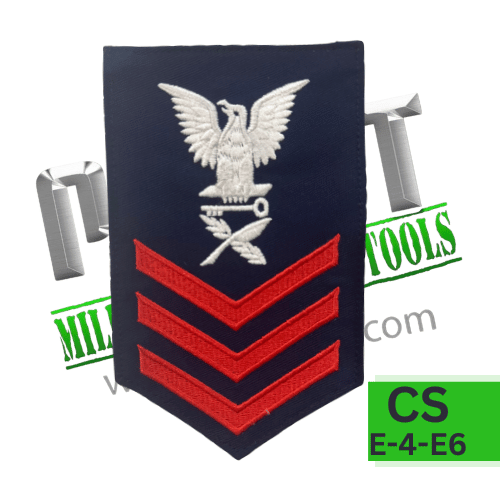
Your USCG rating badge is not just decoration. It communicates your rate/pay grade and, when applicable, your specific rating emblem. COMDTINST M1020.6K describes the rating badge structure as including a perched eagle, chevrons/stars for pay grade, and a rating emblem positioned between the eagle and chevrons to indicate the wearer’s rating.
Official placement for rating badges (sleeve location)
COMDTINST M1020.6K states the rating badge is worn on the outer left sleeve of the Service Dress Blue coat and both Dinner Dress Jackets, placed midway between the shoulder and the elbow and midway between the front and back crease.
The manual also specifies rating badges should have a hem allowing for no more than 1/4 inch excess fabric at the top or bottom prior to placement. That’s a big reason some sleeves look bulky or “homemade” after sewing.
Shop the new Coast Guard options here: USCG Rating Badges.
How to Place USCG Service Stripes and Rating Badges Correctly (Fast, Clean, Repeatable)
This is a quick, practical method you can use at home before you sew (or before you take it to alterations). It’s written to match the official placement rules while helping you avoid common mistakes like crooked angles or incorrect cuff measurements.
Identify the correct uniform coat
Confirm you’re working with the correct coat/jacket (Service Dress Blue coat or Dinner Dress jacket). Service stripes and rating badges are placed on specific garments.
Mark service stripes from the cuff
Place the lowest service stripe at a 45-degree angle with the lower edge exactly 2 inches from the cuff, then add additional stripes spaced 1/4 inch apart.
Center between front and back creases
The manual indicates sleeve items are positioned relative to sleeve creases. Keep stripes and the rating badge centered midway between the front and back crease for a balanced appearance.
Place rating badge mid-shoulder to elbow
Position the rating badge on the outer left sleeve midway between the shoulder and elbow and midway between sleeve creases; ensure no more than 1/4 inch excess fabric at top or bottom.
Do a final mirror check before sewing
Put the coat on (or pin in place) and check alignment from multiple angles. A few millimeters can look obvious once it’s sewn.
Use the official manual as your final authority
If anything conflicts with memory or local advice, verify against COMDTINST M1020.6K before finalizing.
If your goal is a “perfect” appearance in uniform, small accessories help: keeping items aligned, reducing rework, and supporting consistent spacing. Browse: Uniform Accessories.
Official Reference: USCG Uniform Regulations (COMDTINST M1020.6K)
Here is the official PDF reference used for measurements and placement guidance in this post: COMDTINST M1020.6K — USCG Uniform Regulations (PDF) .
Informational resource only. Always confirm the most current guidance and any change notices applicable to your unit and uniform type.


